
- Agronomics
-
Diseases
- Asian Rust
- Anthracnose
- Bacterial Blight
- Bacterial Pustule
- Bean Pod Mottle Virus
- Brown Stem Rot
- Cercospora Leaf Blight
- Charcoal Rot
- Downy Mildew
- Frogeye Leaf Spot
- Green Stem Syndrome
- Iron Deficiency Chlorosis
- Phytophthora Root & Stem Rot
- Powdery Mildew
- Rhizoctonia
- Seedling Diseases
- Septoria (Brown Spot)
- SCN (Soybean Cyst Nematode)
- Soybean Mosaic Virus
- Stem Canker
- Sudden Death Syndrome
- Viruses
- White Mold
- Pests
- Biological Control
- Diagnostic Tools
- About Us
- Library
| Disease: Asian Rust |


Your soybean checkoff.
Delivering Results.
Asian Soybean Rust - Symptoms
|
|
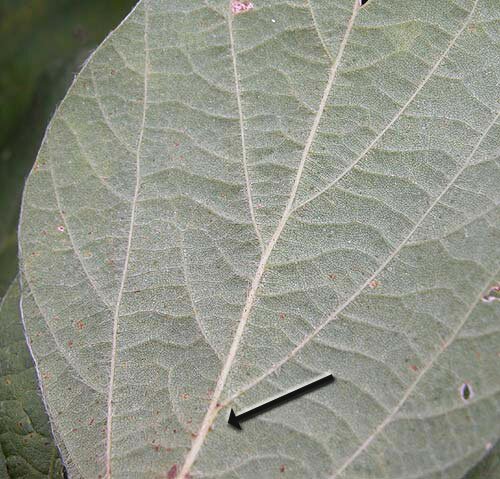
Figure 1. Early symptoms of rust appear on lower leaves deep in the canopy. Photo credit: University of Wisconsin.
Click on image to view a larger version |
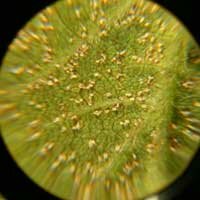 |
| Figure 2. Spores of the rust fungus viewed with a hand lens. |
Rust infection begins in the low to mid-canopy and moves up the plant. The first symptoms are typically small, gray spots on the undersides of leaves and along leaf veins (Figure 1) starting around the flowering stage. The spots increase in size over time and change color from gray, to tan, reddish-brown or black.
It is important to recognize that these symptoms are not exclusive to rust. Other diseases of soybean including brown spot, bacterial blight, and particularly downy mildew all have similar symptoms and can easily be confused with soybean rust.
Soybean plants are susceptible to soybean rust at any stage of development, but symptoms are most common during and after flowering.
If symptoms are observed, look for signs (sporulation) of the rust pathogen
Lesions caused by the rust fungus enlarge, becoming tan or reddish-brown with a raised appearance. These pimple-like structures, called pustules, are diagnostic for Asian soybean rust. When rust pustules are mature, they burst and release masses of spores into the air. Pustules contain powdery spores, which are diagnostic for rust in the field (Figure 2).
As the plant matures and begins to set pods, rust symptoms can spread rapidly to the middle and upper parts of the plant. Lesions are found on petioles, pods, and stems but are most abundant on leaves.
Look-alike diseases
In the early stages, it is easy to confuse the symptoms of soybean rust with symptoms of other soybean leaf diseases Detecting low levels of soybean rust typically requires incubating samples for 24 to 48 hours and observing them under laboratory conditions by a trained diagnostician.
Familiarize yourself with the symptoms and signs of these diseases:
- Brown spot caused by the fungus, Septoria gycines
- Bacterial pustule, caused by Xanthomonas axonopodis pv. glycines
- Bacterial blight (also called angular leaf spot ), caused by Pseudomonas savastanoi pv. glycinea
- Downy mildew
- Frogeye leaf spot
- Cercospora leaf spot
Images of these foliar diseases can be found in Common Soybean Leaf Diseases and Asian Soybean Rust (pdf) by Alison Robertson and Greg Tylka, Iowa State University
View more images of rust in the Photo Gallery