
-
Soybean Diseases
- Asian Rust
- Anthracnose
- Bacterial Blight
- Bacterial Pustule
- Bean Pod Mottle Virus
- Brown Stem Rot
- Cercospora Leaf Blight
- Charcoal Rot
- Downy Mildew
- Frogeye Leaf Spot
- Green Stem Syndrome
- Iron Deficiency Chlorosis
- Phytophthora Root & Stem Rot
- Powdery Mildew
- Rhizoctonia
- Seedling Diseases
- Septoria (Brown Spot)
- SCN (Soybean Cyst Nematode)
- Soybean Mosaic Virus
- Stem Canker
- Sudden Death Syndrome
- Viruses
- White Mold
- Soybean Pests
- Diagnostic Help
- Field Trials
- Soybean Library
| Pest: Bean Leaf Beetle |

Your Soybean Checkoff.
Delivering Results.
Illinois
Indiana
Iowa
Kansas
Michigan
Minnesota
Missouri
Nebraska
North Dakota
Ohio
South Dakota
Wisconsin
Bean Leaf Beetle
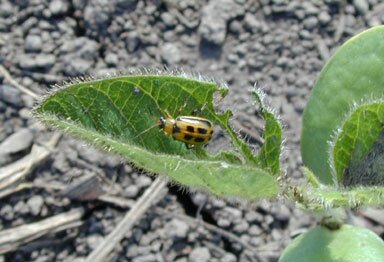 |
| Entomologists in the midwest recommend including bean leaf beetle in the early season scouting schedule. Injury due to beetle feeding is easily recognized. Photo credit: Kevin Black |
The bean leaf beetle (Cerotoma trifurcata) is a common soybean pest that feeds on cotyledons, leaves and pods.
Overwintered bean leaf beetles feed on alfalfa and other legumes in the early spring. As soybeans emerge, the beetles move from legumes to soybeans to continue feeding and lay eggs in the soil.
Early planted soybeans and especially the first fields to emerge in an area is where seedling injury due to feeding by overwintering beetles is most likely to occur.
Feeding injury is recognized by small round or oval holes in the middle of young leaves or on the leaf edge.
Populations of bean leaf beetles have been increasing in the North Central region — it's thought that back-to-back mild winters have favored the survival of overwintering adults.
 |
|
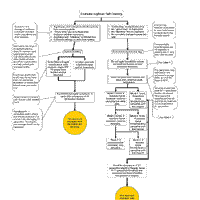
Researchers at Iowa State University have constructed a flowchart to help growers with early-season management decisions. The flowchart is a dynamic, two-pronged decision guide based on field history. View flowchart (pdf)» |
Second-generation beetles are most damaging
Overwintered beetles feed on soybean during May and June in the midwest. Overwintered females lay eggs that develop into first-generation beetles which emerge in July. The first- generation population usually peaks in the early reproductive stage of the soybean crop. Feeding by the over-wintering population or the first-generation beetle does not usually cause yield loss.
However, a second population of beetles peaks during the pod-fill stages, and feeding by this population can cause extensive damage to pods, seed yield, and seed quality. Damaged pods are also more susceptible to rotting and discoloration.
Bean leaf beetles can transmit viruses
In addition to the physical injury to the plant, bean leaf beetles are known to transmit the Bean pod mottle virus (BPMV) from plant to plant as it feeds. The increasing numbers of bean leaf beetles in the region is thought to be the cause of a higher incidence in BPMV observed in recent years.