
-
Soybean Diseases
- Asian Rust
- Anthracnose
- Bacterial Blight
- Bacterial Pustule
- Bean Pod Mottle Virus
- Brown Stem Rot
- Cercospora Leaf Blight
- Charcoal Rot
- Downy Mildew
- Frogeye Leaf Spot
- Green Stem Syndrome
- Iron Deficiency Chlorosis
- Phytophthora Root & Stem Rot
- Powdery Mildew
- Rhizoctonia
- Seedling Diseases
- Septoria (Brown Spot)
- SCN (Soybean Cyst Nematode)
- Soybean Mosaic Virus
- Stem Canker
- Sudden Death Syndrome
- Viruses
- White Mold
- Soybean Pests
- Diagnostic Help
- Field Trials
- Soybean Library
| Disease: Brown Stem Rot |

Your Soybean Checkoff.
Delivering Results.
Illinois
Indiana
Iowa
Kansas
Michigan
Minnesota
Missouri
Nebraska
North Dakota
Ohio
South Dakota
Wisconsin
Brown Stem Rot
Brown stem rot (BSR) is a major disease of soybean and is widely distributed in soybean fields throughout the North Central region. The increase in the incidence of BSR is thought to be a result of shorter rotations between soybean and corn, which encourages a build-up of the brown stem rot pathogen.
Brown stem rot is caused by the fungus Phialophora gregata. The fungus survives mainly on crop residue left on the soil surface. In the spring, spores are produced that infect soybean roots.
The pathogen eventually reaches and invades the vascular system of soybean plants, and impedes the movement of water and nutrients needed for growth. Internal browning of the stem (see photo) is diagnostic for brown stem rot.
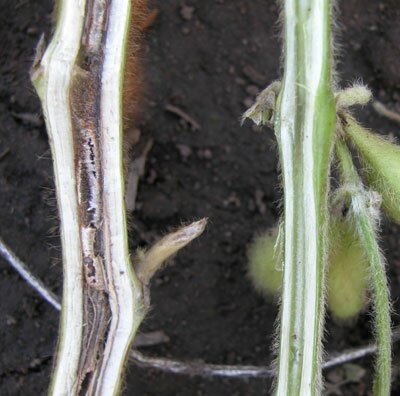 |
| Internal browning, seen on the stem on the left, is diagnostic for brown stem rot. Photo credit: Craig Grau, University of Wisconsin |