
-
Soybean Diseases
- Asian Rust
- Anthracnose
- Bacterial Blight
- Bacterial Pustule
- Bean Pod Mottle Virus
- Brown Stem Rot
- Cercospora Leaf Blight
- Charcoal Rot
- Downy Mildew
- Frogeye Leaf Spot
- Green Stem Syndrome
- Iron Deficiency Chlorosis
- Phytophthora Root & Stem Rot
- Powdery Mildew
- Rhizoctonia
- Seedling Diseases
- Septoria (Brown Spot)
- SCN (Soybean Cyst Nematode)
- Soybean Mosaic Virus
- Stem Canker
- Sudden Death Syndrome
- Viruses
- White Mold
- Soybean Pests
- Diagnostic Help
- Field Trials
- Soybean Library
| Pest: SCN |

Your Soybean Checkoff.
Delivering Results.
Illinois
Indiana
Iowa
Kansas
Michigan
Minnesota
Missouri
Nebraska
North Dakota
Ohio
South Dakota
Wisconsin
Soybean Cyst Nematode
The soybean cyst nematode (SCN) is a small plant-parasitic roundworm (Heterodera glycines ) that feeds on the roots of soybeans. Soybean cyst nematode is one of the most important diseases of soybeans. Yield losses occur because plants are producing fewer pods than they should.
 |
|
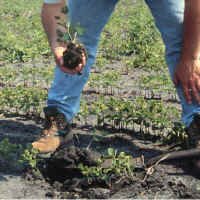
Soil samples taken following harvest provide the best estimates of SCN. Check roots during midseason for the presence of females and cysts. How to sample soil for SCN» How to check roots for SCN» |
Key points to know about SCN
- Many farmers don't know their fields are infested with SCN - you often can't tell SCN is there from looking at the field.
- The effect of SCN on soybean yield is directly related to the numbers of nematodes feeding on the root system.
- Observation of adult females and cysts on the roots of soybean plants is the most accurate way to diagnose SCN infestation in the field.
- Once present in the soil, SCN can never be eliminated. However, the nematode can be managed to minimize SCN reproduction and maximize crop yields.
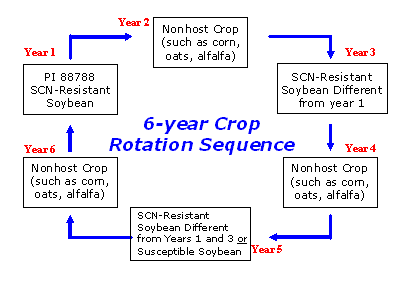
- Crop rotation coupled with planting SCN-resistant varieties are the cornerstones for the management of SCN. Non-host crops, such as corn, sorghum, sunflower, and alfalfa can reduce SCN population densities each year a non-host crop is planted.
- Anything that can move even small amounts of infested soil is capable of spreading SCN, including farm machinery, vehicles and tools, wind, water, animals, and farm workers.
Choosing SCN-resistant soybean varieties
 |
|
The popular SCN Management Guide is based on decades of research on soybean management in SCN-infested fields. It's now in it's 5th edition. Read online (pdf)» |
Crop rotation and planting SCN-resistant varieties are the two most important strategies of SCN management.
To choose SCN-resistant varieties, look for those that yield consistently well in SCN-infested fields on multiple sites (yield data from noninfested fields are not useful).
Also look for varieties that consistently decrease SCN population densities or keep the SCN numbers in check in multiple fields. It is very difficult to reduce SCN numbers in a field once they develop to high levels, so it is important to consider how well SCN-resistant varieties control SCN numbers in order to maintain the productivity of fields for years to come.
Look for data from as many different reliable sources as possible, including university variety trials and strip trials conducted by co-ops, grain elevators, and seed companies.
Remember that high-yielding varieties don’t always control SCN population densities the best, so pay attention to information about SCN reproduction in the field as well as yield. Wise selection of varieties will ensure that soybeans can be grown profitably in SCN-infested fields for many years to come.
| Recommended crop rotations to manage SCN in fields with less than 5000 eggs/100 cc soil. Greg Tylka, Iowa State University. |
 |