
-
Soybean Diseases
- Asian Rust
- Anthracnose
- Bacterial Blight
- Bacterial Pustule
- Bean Pod Mottle Virus
- Brown Stem Rot
- Cercospora Leaf Blight
- Charcoal Rot
- Downy Mildew
- Frogeye Leaf Spot
- Green Stem Syndrome
- Iron Deficiency Chlorosis
- Phytophthora Root & Stem Rot
- Powdery Mildew
- Rhizoctonia
- Seedling Diseases
- Septoria (Brown Spot)
- SCN (Soybean Cyst Nematode)
- Soybean Mosaic Virus
- Stem Canker
- Sudden Death Syndrome
- Viruses
- White Mold
- Pests
- BioControl
- Diagnostic Tools
- About PHI
- Soybean Library
| Pest: SCN |

Your Soybean Checkoff.
Delivering Results.
University of Illinois
Southern Illinois University
Iowa State University
Kansas State University
Michigan State University
University of Minnesota
University of Missouri
University of Nebraska
North Dakota State University
Ohio State University
Purdue University
South Dakota State University
University of Wisconsin
Scouting for SCN in stunted or yellow soybeans,
OR scouting a field that is apparantly healthy — for new infestations or to assess the effectiveness of a SCN-resistant variety
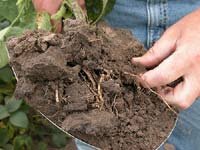 |
| Adult females of SCN can be seen on roots without magnification Click on image to view a close-up. Photo credit: Greg Tylka, Iowa State University |
Recommended technique
Carefully observing soybean roots for SCN females is a good way to check fields for infestations that have not yet been discovered. It also is an effective way to assess how well SCN-resistant soybean varieties are controlling nematode reproduction in fields known to be infested with SCN. There should be only a few, not more than 10 to 20, SCN females on the roots of a resistant variety if the variety is effectively controlling the nematode.
When to sample
You can scout your fields for SCN by digging plants no sooner than 6 weeks after planting and up to 3 or 4 weeks before harvest. Earlier is better, though because the females and cysts occur on new roots that can be easily dug from the soil surrounding the base of the stem of the plant. July and August are good times. Later in the season, adult SCN females and cysts appear on new roots that are located deeper down in the soil as well as farther laterally from the stem of the plant.
| ISU Nematologist Greg Tylka demonstrates how to check for SCN females on soybean roots during the growing season. |
How to sample
Use your shovel to dig up yellow and/or stunted soybean plants. You want to dig at least 6 to 8 inches away from the plant stem to make sure you haven't cut off much of the root system.
Never try to pull up a plant to see SCN, you'll lose too much of the root system and strip off the nematode females as you pull the root system through the soil. Gently shake excess soil from the root system.
Check the root system for adult SCN females. They will be a lot smaller than the nitrogen-fixing nodules, about the size of the period at the end of a printed sentence. They will be white or light yellow and lemon-shaped. A magnifying glass or land lens might help you see the females. SCN females are easier to see in dark soils than in light soils
Where to sample
I f you are scouting a field that has never been checked for SCN, consider that SCN can be in a field for many years without the tops of the plants becoming yellow or stunted. For this reason, it is a good idea to include healthy-looking plants in your scouting. A good place to start are in areas that have a higher risk for SCN, such as
-
near a field entrance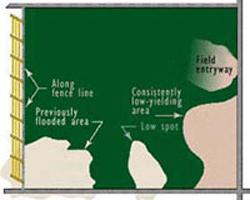
- areas that have been flooded at one time
- areas of high soil pH (greater than 7)
- areas where weed control isn't quite as good
- areas where the yield seemed to be a little low the last time soybeans were grown
- along fence lines where wind-blown soil accumulates.
What to do if SCN is detected
If when scouting your fields, you found SCN females on the roots, or if you weren't able to find females but still suspect SCN is present, you'll want to take soil samples and have them tested for SCN. A soil test is the best way to estimate the SCN population density in your field that will help to determine guidelines for managing SCN.
Adapted from SCN Symptoms and Soil Sampling slide set, courtesy of Greg Tylka, Iowa State University.
Questions? Please contact Iowa State University