
-
Soybean Diseases
- Asian Rust
- Anthracnose
- Bacterial Blight
- Bacterial Pustule
- Bean Pod Mottle Virus
- Brown Stem Rot
- Cercospora Leaf Blight
- Charcoal Rot
- Downy Mildew
- Frogeye Leaf Spot
- Green Stem Syndrome
- Iron Deficiency Chlorosis
- Phytophthora Root & Stem Rot
- Powdery Mildew
- Rhizoctonia
- Seedling Diseases
- Septoria (Brown Spot)
- SCN (Soybean Cyst Nematode)
- Soybean Mosaic Virus
- Stem Canker
- Sudden Death Syndrome
- Viruses
- White Mold
- Soybean Pests
- Diagnostic Help
- Field Trials
- Soybean Library
| Disease: SDS |
| Basics |
| Disease cycle |
| Symptoms |
| Scouting |
| Agronomic impact |
| Risk assessment |
| Management |
| Research reports |
| Variety trials |
| Links to more resources |

Your Soybean Checkoff.
Delivering Results.
Illinois
Indiana
Iowa
Kansas
Michigan
Minnesota
Missouri
Nebraska
North Dakota
Ohio
South Dakota
Wisconsin
Sudden Death Syndrome
 |
|
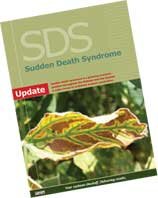
SDS: Finding solutions for farmers NCSRP has put together a 12-page report on SDS, packed with current research-based information about this complex disease and how to manage it. Order your free print copy by calling 1- (orders for mailing within the U.S. only, please), or read online (pdf)» |
Sudden death syndrome (SDS) is a soybean disease characterized by both leaf spots and root decay. The name sudden death syndrome is descriptive in that normal-appearing plants turn yellow and die rather quickly.
The disease is of major concern because of its potential ability to reduce yields — from a slight yield loss to 100%, depending on the soybean variety.
SDS is now considered one of the top four yield-robbing diseases in soybean, and appears to be spreading.
 |
| Leaf symptoms of SDS. Photo credit: S. Navi, Iowa State University |
Recognizing SDS
SDS is first noticed by the appearance of yellow and black spots between the leaf veins. This can occur anytime during the growing season, but is most common during the late flowering or early reproductive growth stages.
Leaf spots caused by the SDS pathogen look very similar those caused by the brown stem rot pathogen. Split the stems of infected plants: if the center of the stem is brown, it's brown stem rot. It it's white, it's SDS. Note, however, that the two pathogens can occur in the same field.
 |
| The fungus that causes SDS has been found inside SCN cysts. Photo credit: Albert Tenuta |
SDS is commonly associated with the soybean cyst nematode
The SDS pathogen has been found in the cysts of soybean cyst nematode (SCN) , and is likely spreading north with the movement of SCN. Because of this close association between SDS and SCN, assume that if you have one or the other, you probably have both. Test for SCN and make management decisions based on both.