
-
Soybean Diseases
- Asian Rust
- Anthracnose
- Bacterial Blight
- Bacterial Pustule
- Bean Pod Mottle Virus
- Brown Stem Rot
- Cercospora Leaf Blight
- Charcoal Rot
- Downy Mildew
- Frogeye Leaf Spot
- Green Stem Syndrome
- Iron Deficiency Chlorosis
- Phytophthora Root & Stem Rot
- Powdery Mildew
- Rhizoctonia
- Seedling Diseases
- Septoria (Brown Spot)
- SCN (Soybean Cyst Nematode)
- Soybean Mosaic Virus
- Stem Canker
- Sudden Death Syndrome
- Viruses
- White Mold
- Soybean Pests
- Diagnostic Help
- Field Trials
- Soybean Library
| Disease: Charcoal Rot |

Your Soybean Checkoff.
Delivering Results.
Illinois
Indiana
Iowa
Kansas
Michigan
Minnesota
Missouri
Nebraska
North Dakota
Ohio
South Dakota
Wisconsin
Charcoal Rot
|
|
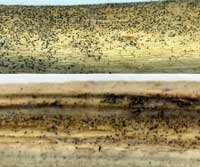
Tiny dark fungal structures on stem, pith and root tissue look like charcoal dust.
Click on image to view a larger version. Photo credit: Chris Little, Kansas State University |
|
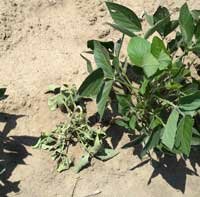
| Early death due to charcoal rot infection during drought conditions Click on image to view a larger version. Photo credit: Chris Little, Kansas State University. |
Charcoal rot is a root disease caused by a common soil fungus Macrophomina phaseolina. Charcoal rot is endemic in southern states and is a major problem in the central part of the Midwest, especially in Kansas and parts of Missouri. It is now occuring with greater frequency in the upper Midwest, with outbreaks reported in Illinois, Indiana, Iowa, Minnesota, North Dakota and Wisconsin.
The fungus causes a general root rot in soybean, infecting the roots and lower stems. The name charcoal rot is descriptive of the small black fungal structures on the lower stem of infected plants.
Plants of any age can be affected by charcoal rot. The initial infection occurs in the spring when soil moisture is high. However, symptoms remain latent unless stressful environmental conditions, especially hot, dry weather, occur during the mid- to late season as the crop begins to flower and form pods.
Periods of hot, dry growing conditions (82 to 95°F) favor pathogen growth and survival and weaken the crop. Under these conditions, severe charcoal rot infection can cause wilting and premature plant death.
Charcoal rot fungus has a broad host range
The pathogen can infect over 500 different kinds of plants. It causes stalk rot on corn and infects many of important agronomic and pasture crops such as soybean, grain sorghum, sunflowers,cotton, alfalfa and white clover.