
-
Soybean Diseases
- Asian Rust
- Anthracnose
- Bacterial Blight
- Bacterial Pustule
- Bean Pod Mottle Virus
- Brown Stem Rot
- Cercospora Leaf Blight
- Charcoal Rot
- Downy Mildew
- Frogeye Leaf Spot
- Green Stem Syndrome
- Iron Deficiency Chlorosis
- Phytophthora Root & Stem Rot
- Powdery Mildew
- Rhizoctonia
- Seedling Diseases
- Septoria (Brown Spot)
- SCN (Soybean Cyst Nematode)
- Soybean Mosaic Virus
- Stem Canker
- Sudden Death Syndrome
- Viruses
- White Mold
- Soybean Pests
- Diagnostic Help
- Field Trials
- Soybean Library
| Disease: Viruses |

Your Soybean Checkoff.
Delivering Results.
Illinois
Indiana
Iowa
Kansas
Michigan
Minnesota
Missouri
Nebraska
North Dakota
Ohio
South Dakota
Wisconsin
Soybean Viruses
 |
|
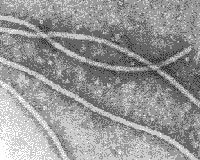
A view of virus particles taken with an electron microscope.
|
|
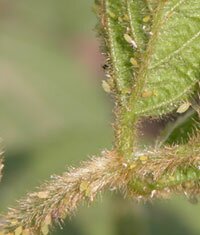
| Most soybean viruses are spread by insect vectors, such as the soybean aphid. Click on image to view a larger version. Photo credit: University of Wisconsin. |
Viruses are submicroscopic particles of DNA or RNA that can cause disease in plants. They can grow and reproduce only inside a living plant cell.
Virus-like symptoms have been increasing in midwestern soybean fields in recent years. Mottled, crinkled leaves during periods of rapid growth, mottled seed, and lower than expected yields can be possible signs of virus infection.
The impact and management of soybean viruses in the midwest is currently an active area of research.
Insect-virus complex
Unlike other soybean pathogens, which are spread by wind, water, soil or plant debris, most plant viruses are spread from plant to plant by specific insect vectors.
The insects that most commonly transmit viruses in soybean are bean leaf beetle (Cerotoma trifurcata), the soybean aphid (Aphis glycines) and other migratory aphid species, and thrips. Recognizing the virus as part of a unique plant-insect-virus relationship is the key to effective management.
Major soybean viruses
Bean pod mottle virus (BPMV) and Soybean mosaic virus (SMV) have historically been the most important viruses in the north-central region. However, recent surveys have identified the presence of Alfalfa mosaic virus (AMV), Soybean dwarf virus (SbDV), Soybean vein necrotic virus (SVNV), Tobacco ringspot virus (TRV), and Tobacco streak virus (TSV) in midwestern soybean fields.
Viruses have been identified in symptomatic and nonsymptomatic plants, often in dual or multiple infections. Multiple infections pose the greatest risk of reduced quality and yield.
Bean pod mottle virus (BPMV)
BPMV is the most common and widespread viral pathogen of soybean in the region. BPMV is transmitted by leaf-feeding beetles, primarily the bean leaf beetle Cerotoma trifurcata. The incidence of BPMV infection in soybean fields can be very high in years when overwintering bean leaf beetle populations are high. Milder winters are thought to be contributing to regular high overwintering populations of the beetle.

|
|
Aphids feeding on soybean leaves with symptoms of soybean mosaic virus. Click on image to view a larger version. Photo credit: University of Illinois, Laboratory for Soybean Disease Research |
Soybean mosaic virus (SMV)
Soybean mosaic virus is transmitted through seed at rates ranging from 0 to 5% in most commercial varieties, and by several species of aphids, including soybean aphid, Aphis glycines.
The incidence of SMV infection in soybean fields has been much lower than that reported for BPMV. However, yield losses from SMV infection in the region have been as high as 94%. When soybean plants are infected with both BPMV and SMV, symptoms can be more severe than infection by either virus alone.
Alfalfa mosaic virus (AMV)
Alfalfa mosaic virus is transmitted by several aphids species, including the soybean aphid, and also through seed. Alfalfa and clover plants in the region are commonly infected with AMV. Symptoms of AMV tend to decrease as the soybean plant matures.
Soybean dwarf virus (SbDV)
SbDV causes severe yield losses in soybean in Japan. SbDV has been detected in more than 40% of red clover plants sampled in Illinois, and has been consistently detected in commercial soybean fields in both Illinois and Wisconsin. Although SbDV has been shown to be transmitted by soybean aphids, the SbDV incidence in Illinois and Wisconsin have not been correlated with annual aphid abundance as determined by the North Central Regional Soybean Aphid Suction Trap Network.
|
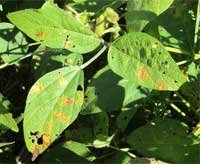
| Visual symptoms of soybean vein necrosis virus begin with yellow spots on leaves, which progresses to dead leaves later in the season. Click on image to view a larger version. Photo credit: Melvin Newman, University of Tennessee |
Soybean vein necrosis virus (SVNV)
SVNV is a new virus that was discovered in soybean in Tennessee in 2008, detected in soybean in Illinois and Kentucky in 2009, and caused widespread, significant damage in soybean fields in Arkansas in 2010. Infection by SVNV initially induces vein clearing that becomes dead tissue as the leaves mature. The incidence of SVNV in commercial soybean fields, and the economic impact of SVNV infections on soybean production have not yet been determined.
Tobacco ringspot virus (TRSV)
Of the many diseases caused by TRSV, budblight of soybeans is one of the the most severe. In general, most significant yield loss occurs when plants become infected before flowering.
The primary source of TRSV in soybeans is not clear. Seed transmission occurs, but at a very low rate.The dagger nematode can spread TRSV to some host species as it feeds, but transmission efficiency to soybean is low.
Several insect vectors have been reported, including aphids Myzus persicae and Aphis gossypii, grasshoppers, the tobacco flea beetle, and thrips.
Tobacco streak virus (TSV)
Tobacco streak virus is transmitted by thrips, and through infected soybean seed. It is capable of reducing yield. TSV infection can be difficult to detect because the concentration of TSV particles decline significantly as soybean plants mature.