
-
Soybean Diseases
- Asian Rust
- Anthracnose
- Bacterial Blight
- Bacterial Pustule
- Bean Pod Mottle Virus
- Brown Stem Rot
- Cercospora Leaf Blight
- Charcoal Rot
- Downy Mildew
- Frogeye Leaf Spot
- Green Stem Syndrome
- Iron Deficiency Chlorosis
- Phytophthora Root & Stem Rot
- Powdery Mildew
- Rhizoctonia
- Seedling Diseases
- Septoria (Brown Spot)
- SCN (Soybean Cyst Nematode)
- Soybean Mosaic Virus
- Stem Canker
- Sudden Death Syndrome
- Viruses
- White Mold
- Soybean Pests
- Diagnostic Help
- Field Trials
- Soybean Library

Your Soybean Checkoff.
Delivering Results.
Illinois
Indiana
Iowa
Kansas
Michigan
Minnesota
Missouri
Nebraska
North Dakota
Ohio
South Dakota
Wisconsin
Brown Marmorated Stink Bug (Halyomorpha halys) - a new invasive pest
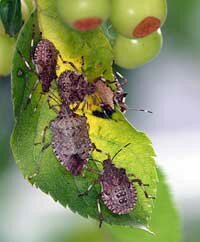 |
| The brown marmorated stink bug, like all stink bugs, tend to aggregate at food sites. Click on image to view a larger version. Photo credit: G. Hamilton, Rutgers University |
 |
| From left to right, four nymphal stages of BMSB, second through fifth instar; adult male, and adult female. Click on image to view a larger version. Photo credit: W. Hershberger, Stop BSMB. |
 |
| Spined soldier bug - a beneficial bug that preys on insect pests. |
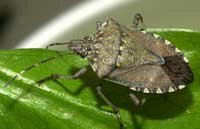 |
| The Brown marmorated stink bug (above) is not the same as the native brown stink bug (below), although they look very similar. Photo credit: D. Lance USDA APHIS |
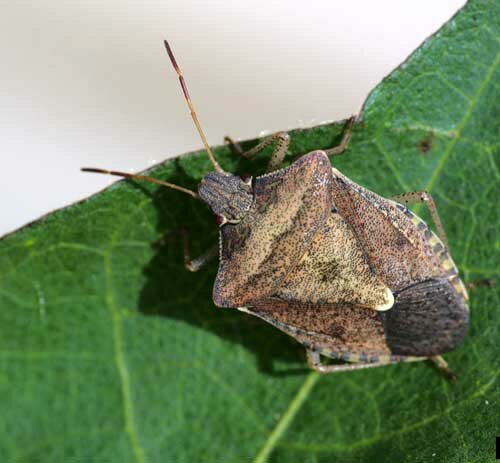 |
| Native brown stink bug. Photo credit: Russ Ottens, University of Georgia. |
The Brown Marmorated Stink Bug (BMSB) is native to Asia but has been unintentially transported to the United States. The presence of these bugs is a concern because they can cause injury to a variety of crops and ornamentals including but not limited to pear, peach, mulberry, persimmon and apple trees, as well as soybeans and various shade trees.
BMSB was first found in Pennsylvania in 1998. As of December 2012, BMSB has been found in 39 states, and has caused greatest crop damage in the mid-Atlantic region.
Although the pest has been confimed in most north central states, it has not been found in soybean fields. To date, confirmed reports of this pest are limited to homes and packages received from out of state.
Impact
There is concern that established populations of BMSB could become pests in crops, gardens, and landscapes in the midwest, as they have in eastern states. BMSB feeds on sap of host plants including field crops (particularly legumes, including soybeans), as well as many fruits, vegetables, shade trees and other woody ornamentals. The bug feeds by puncturing plant tissues, especially fruits and seed pods, and sucking out the plant juices with its mouthpart, similar to aphids or leafhoppers.
In addition to the damage they do to crops, BSMB adults annoyingly migrate into houses and other buildings in the fall to overwinter. In fact, homeowners are generally the first to notice the BSMB’s presence as it invades their homes. Homeowners on the East Coast describe the stink bugs as worse than box elder bugs and lady beetles combined. Fortunately, the stink bug will not reproduce inside structures or cause damage.
Identification
“Marmorated” describes the BMSB’s marble-like coloration on the body. Adults are approximately one-inch long, with the typical shield shape of a stink bug. The characteristics that set it apart from other stink bugs are the white banding on the antennae, the distinctive pattern on the edge of its wings, and its red eyes. BMSB have small, round, copper-colored or metallic blue depressions on the head.
Nymphs have a yellowish to off-white abdomen, and just before adulthood, their abdomens have reddish spots.
Green and brown stink bugs
In spite of recent attention to the BSMB, farmers should also be aware of several other stink bugs that can be found in north central soybeans. Many producers are familiar with green stink bugs (Acrosternum hilare) and brown stink bugs (Euschistus servus) in fields. These bugs are attracted to soybean plants in the bloom to early pod-fill stages when they begin feeding on developing seed. Direct feeding can lead to reduced seed quality and secondary seed rot.
Beneficial stink bugs
Not all stink bugs found in soybean fields are pests. Some are beneficial. The spined soldier bug is a common stink bug species that preys on pest insects, especially larval forms of pest caterpillars and beetles. The spined soldier bug is found in soybeans after blooming and can be identified by very sharp pointed “shoulders” and dark wing tips.
Monitoring efforts
Though stink bugs are considered a major pest of soybeans in the southern parts of the country, they have not yet become a significant cause for concern among Midwestern farmers.
Farmers and homeowners who observe insects similar to the BMSB are encouraged to submit a sample or send a digital photo to their state university diagnostic clinic or their state agricultural pest survey office.
A national working group is monitoring the spread and distribution of BSMB and posts updated maps on thei Stop BMSB website.
>view map of BMSB distribution.
 |
|
With funding from USDA’s Specialty Crop Research Initiative, a team of 50 researchers has mobilized to find management solutions for BMSB. Visit their comprehensive website, Stop BMSB, which includes a BMSB distribution map |
Links to more information
Stop BSMB website - USDA
Brown Marmorated Stink Bug: Know This Invasive! University of Illinois, Extension
Stink Bugs and Similar-Appearing Insects in Iowa Iowa State University Plant and Insect Diagnostic Clinic
Stink Bugs on the Move Integrated Crop Management News, Iowa State University
Brown Marmorated Stink Bug: Ohio State University Extension Fact Sheet FS-3824-08 (printable pdf)