
-
Soybean Diseases
- Asian Rust
- Anthracnose
- Bacterial Blight
- Bacterial Pustule
- Bean Pod Mottle Virus
- Brown Stem Rot
- Cercospora Leaf Blight
- Charcoal Rot
- Downy Mildew
- Frogeye Leaf Spot
- Green Stem Syndrome
- Iron Deficiency Chlorosis
- Phytophthora Root & Stem Rot
- Powdery Mildew
- Rhizoctonia
- Seedling Diseases
- Septoria (Brown Spot)
- SCN (Soybean Cyst Nematode)
- Soybean Mosaic Virus
- Stem Canker
- Sudden Death Syndrome
- Viruses
- White Mold
- Soybean Pests
- Diagnostic Help
- Field Trials
- Soybean Library
Search the site

Your Soybean Checkoff.
Delivering Results.
Illinois
Indiana
Iowa
Kansas
Michigan
Minnesota
Missouri
Nebraska
North Dakota
Ohio
South Dakota
Wisconsin
Getting Diagnostic Help
-
First, check with your state diagnostic clinic about the possiblity of distance diagnosis. Sending in a series of good quality digital pictures to a diagnostician can be an effective way of identifying the problem, and avoids many of the problems associated with sending samples by mail, such as including the wrong plant parts, delays in turn-around-time, and deterioration of the samples.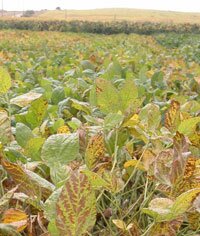
- Even if the plant problem can't be diagnosed with certainty from the pictures, they can be used to guide the on-site sampling, what additional information may be needed, and whether or not soil or plant samples for nutrient analysis are needed.
- If collecting living plants, choose those that are in varying stages of decline. Do not submit dead plants — they will decay before diagnosticians can examine them. Be sure the specimens represent the problem. Include enough plant material to show all stages of the disease from healthy to very sick. For virus tests, be sure to send green, symptomatic leaves.
- Send several whole plants, roots and all. Dig roots, rather than pull.
- Include a cropping history and the pattern of symptoms in the field. Include a photo, if possible. Some diseases tend to be distributed in a characteristic pattern.
- Include other information: description of the soil, nearby plants, and a history of the problem. Include photos when possible. Most clinics have an Information Request Form to include with the sample. You can print these out from the clinic website...find your clinic»
- Wrap specimens in paper towels or clean newspapers. Do not add moisture. Pack loosely in a plastic bag to reduce drying. Keep specimens cool and mail the same day.
- For mailing, use strong containers like corrugated boxes or mailing tubes that will not crush in transit. Fill empty spaces in mailing cartons with crushed or shredded paper to protect the specimen.
- Use overnight mail services or mail packages early in the week to avoid weekend layovers at the post office. Careful packaging and quick delivery of the specimens is essential.
- Most clinics request payment with each sample. Make checks payable to the University where the clinic is located. You can find out the fee by checking the clinic website...find your clinic»