
- Agronomics
-
Diseases
- Asian Rust
- Anthracnose
- Bacterial Blight
- Bacterial Pustule
- Bean Pod Mottle Virus
- Brown Stem Rot
- Cercospora Leaf Blight
- Charcoal Rot
- Downy Mildew
- Frogeye Leaf Spot
- Green Stem Syndrome
- Iron Deficiency Chlorosis
- Phytophthora Root & Stem Rot
- Powdery Mildew
- Rhizoctonia
- Seedling Diseases
- Septoria (Brown Spot)
- SCN (Soybean Cyst Nematode)
- Soybean Mosaic Virus
- Stem Canker
- Sudden Death Syndrome
- Viruses
- White Mold
- Pests
- Biological Control
- Diagnostic Tools
- About Us
- Library
| Disease: Asian Rust |


Your soybean checkoff.
Delivering Results.
Scouting for Asian Soybean Rust
When to scout
-
The most critical time to scout is the R1 to R5 growth stages.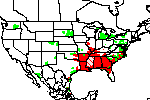
Check the USDA ipmPIPE soybean rust maps frequently during the growing season. - Scout if soybean rust has been reported in your area. You can follow the movement of rust from the southern states northward on the USDA ipmPIPE web maps. If rust development in the southern U.S. is slow, scouting in the North Central region can be delayed.
- Scout if a large scale storm from a southernly direction has moved through your area.
If you think you may have soybean rust of your farm, work with your Certified Crop Advisor, your local extension agent, or certified professional agronomist to collect a sample for confirmation.
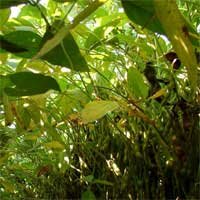 |
| Soybean rust will develop in the lower canopy first. Photo credit: Iowa State University |
Areas to scout
- Early-planted fields
- Early-maturing varieties
- Low-lying or protected fields with prolonged dew periods where leaves stay wet longer
- Fields with early canopy closure
How to check a field for rust
- Walk through the entire field in a standard Z or W scouting pattern, checking plants as you go. Take a hand lens with you.
- Look deep into the low to mid-canopy. Leaves from the lower canopy will show symptoms first. Select leaves from the main stem only. Leaves from the lateral branches are less mature, even if picked from the same height.
-
Look for small, gray spots, particularly on the undersides of leaves and along leaf veins. Backlighting may enhance the viewing of early symptoms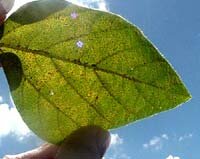
Backlighting may enhance the viewing of early symptoms.
Click on the image to view a larger verson.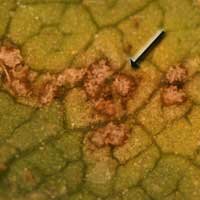
Rust spores emerge from pustules on the underside of the soybean leaf (magnified). Photo credit: Carl Bradley, University of Illimois
Click on image to view a larger version. - Older lesions are larger and change color from gray, to tan, reddish-brown or black. It is important to recognize that these symptoms are not exclusive to rust. Brown spot, bacterial pustule, bacterial blight, Cercospora, frog eye leaf spot, and particularly downy mildew can easily be confused with soybean rust.
Detecting low levels of soybean rust typically requires incubating samples for 24 to 48 hours and observing them under laboratory conditions by a trained diagnostician. - If soybean rust has become severe enough to be identified in the field, examine the underside of leaves for active pustules containing powdery tan spores of the rust fungus. The presence of sporulation is diagnostic for rust in the field.
Adapted from: Scouting for Soybean Rust, University of Wisconsin and Common Soybean Leaf Diseases and Asian Soybean Rust (pdf) Alison Robertson and Greg Tylka, Iowa State University
What to do if you suspect soybean rust on your farm
If rust is suspected, work with your Certified Crop Advisor, your local extension agent, or certified professional agronomist to collect a sample for confirmation. Check here for contact information for the university-based plant disease clinic in your state.
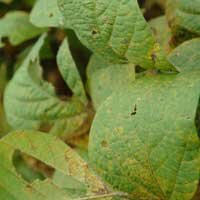 |
| Detecting low levels of soybean rust typically requires incubating samples for 24 to 48 hours and observing them under laboratory conditions by a trained diagnostician. |
Place leaf, stem or pod samples in a self-locking plastic bag and store under cool conditions. It would be helpful if leaves can be placed between paper towels or pieces of paper to keep them flat. Care should be taken to ensure the outside of the bags are not contaminated by the sample.
Samples that must be kept under ambient conditions should be sealed in a paper bag to prevent mold growth. Once they can be refrigerated, the paper bag can be place in a self-locking plastic bag.
Include the following information with the sample:
- date
- county
- exact location of the field
- sample location within the field
- host plant
- collector's name and phone number.
Source: USDA-APHIS