
-
Diseases
- Asian Rust
- Anthracnose
- Bacterial Blight
- Bacterial Pustule
- Bean Pod Mottle Virus
- Brown Stem Rot
- Cercospora Leaf Blight
- Charcoal Rot
- Downy Mildew
- Frogeye Leaf Spot
- Green Stem Syndrome
- Iron Deficiency Chlorosis
- Phytophthora Root & Stem Rot
- Powdery Mildew
- Rhizoctonia
- Seedling Diseases
- Septoria (Brown Spot)
- SCN (Soybean Cyst Nematode)
- Soybean Mosaic Virus
- Stem Canker
- Sudden Death Syndrome
- Viruses
- White Mold
- Pests
- Biological Control
- Agronomics
- Diagnostic Tools
- About Us
- Library
| Pest: Aphids |
| Aphid natural enemies |
| Links to state resources |


Your soybean checkoff.
Delivering Results.
Soybean aphid parasitoids
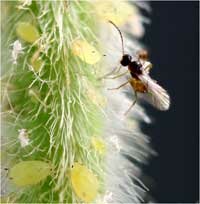 |
| Binodoxys communis parasitizing soybean aphids. Photo credit: Kelley Tilmon, South Dakota State University |
Parasitic wasps (parasitoids) is considered one of the most important groups of natural enemies of aphids, and play a large role in suppressing soybean aphid in Asia, where the aphid is only a minor pest. The North Central Soybean Research Program has invested in a importation biological control effort to import and establish one or more of these species to attain long-term suppression of soybean aphid, as is seen naturally in Asia.
One of the most promising candidates for importation biological control was Binodoxys communis, which was the first to be granted a release permit in 2007 and 2008.
Binodoxys communis is a tiny non-stinging parasitoid wasp that parasitizes and ultimately kills soybean aphids. It belongs to the insect order Hymenoptera (ants, wasps, bees and sawflies), and is in the family Braconidae. Braconid wasps
Unfortunately, Binodoxys communis has not established and it is now thought to have lost the ability to enter diapause. However, permits are pending for two other promising species. And much has been learned about the biology, testing, and release of soybean aphid parasitoids. The life cycle of B. communis illustrates how this works.
Life Cycle of B. communis
Like all parasitoids, B. communis uses an egg-laying organ called the ovipositor to lay a single egg inside each aphid host. When the egg hatches, the legless cream-colored larva starts feeding on the aphid’s blood and organs. As it consumes the aphid from the inside out, the larva grows and develops through several stages ultimately killing its host. Because it feeds internally within the aphid, it is called an endoparasitoid.
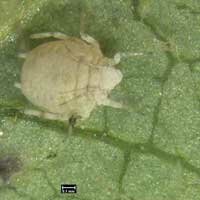 |
| An aphid killed by the parasitoid, Binodoxys communis. Photo credit: Dan Mahr, University of Wisconsin |
When the parasitoid larva finishes feeding, the only part remaining of the aphid is its empty skin, which appears puffed up, brown and hardened. The “mummy”, as the shell of the dead parasitized aphid is called, is usually formed 6 to 8 days after parasitization, and this is where the larva pupates and transforms into an adult. In the pupating process the parasitoid larva glues the mummy to the plant surface and spins a cocoon inside where it remains protected. Four to six days later, the adult wasp chews a round hole in the aphid shell and emerges from it. After emergence, males seek females for mating and females start seeking suitable aphid hosts to attack.
Females have the potential to lay up to 200 eggs, depending on the temperature, humidity, parasitoid population density, and soybean aphid numbers and quality. Adults feed only on water, flower nectar, honey dew, or other sugar sources. Many parasitoid species have been observed on floral nectar in fields, and research suggests that crops with nearby flowering vegetation have higher parasitism rates.
The whole process from egg to adult emergence takes between 10 and 14 days, and adults live about 10 days. Since females start reproducing almost immediately after emergence, it takes about 10 to 14 days for an entire generation to be completed. The number of generations per year is not yet known.
The overwintering habits of B. communis has been an area of active research, and it is now thought that it does not successfully enter diapause. Parasitoids must either disperse with the soybean aphid to buckthorn or use an alternate aphid host, otherwise it would not survive after soybean is harvested or not available.
 |
| Check soybean leaves for the presence of aphid mummies - a sign of parasitoids at work. Photo credit: Roy Scott |
Control of soybean aphids by B. communis and other parasitoids
Research suggests that B. communis is most effective as a natural enemy under low soybean aphid densities, and as aphid numbers increase, the amount of parasitization decreases. This may be because dense aphid colonies tend to attract predators (particularly Asian lady beetles) which not only prey on soybean aphids but on parasitized aphids and mummies as well. Therefore, parasitoids are probably most effective in early season when soybean aphid numbers are low, preventing high density aphid colonies from building up in soybean fields.
How to scout for parasitoids in the field
B. communis, as with most parasitoids, is smaller than a pinhead and usually walks or makes small flights throughout soybean plants searching for suitable hosts. It is difficult to see in the field, so the best and more reliable way to determine its presence is by searching for it's mummies. The advantage of searching for mummies rather than for the adult is that they are easy to see, they conserve their shape, and they stay attached to the plant even after the adult parasitoid has already emerged from it.
Contributed by Camila Botero, University of Wisconsin