
- Agronomics
-
Diseases
- Asian Rust
- Anthracnose
- Bacterial Blight
- Bacterial Pustule
- Bean Pod Mottle Virus
- Brown Stem Rot
- Cercospora Leaf Blight
- Charcoal Rot
- Downy Mildew
- Frogeye Leaf Spot
- Green Stem Syndrome
- Iron Deficiency Chlorosis
- Phytophthora Root & Stem Rot
- Powdery Mildew
- Rhizoctonia
- Seedling Diseases
- Septoria (Brown Spot)
- SCN (Soybean Cyst Nematode)
- Soybean Mosaic Virus
- Stem Canker
- Sudden Death Syndrome
- Viruses
- White Mold
- Pests
- Biological Control
- Diagnostic Tools
- About Us
- Library
| Pest: Aphids |
| Aphid natural enemies |
| Links to state resources |


Your soybean checkoff.
Delivering Results.
Scouting soybean aphids

|
| Aphids typically feed on the undersides of actively-growing new leaves. Click on image to view a larger version Photo credit: University of Wisconsin. |
 |
| Aphids, winged aphids, and cast skins are visible in this photo. Photo credit: Michigan State University |
Aphids can infest a soybean field at any time during the growing season. Start spot-checking seedling soybean and continue checking through pod fill.
The insect is small (1/16 inch), pear-shaped bright green to yellow with dark tips on the cornicles (two tube-like structures or "tailpipes" on the tip of the abdomen).
Populations can build in July
Scout more intensively beginning at late vegetative growth stage soybeans (mid-July) and calculate the average aphids per plant on 20-30 plants per field, from a sample covering at least 80% of the field area. Check the entire plant; at this stage aphids move from the top of the plant to the middle or lower areas of the canopy. Check the undersides of leaves, petioles and pods.
Take note of the presence of winged aphids and alatoid nymphs (with wing pads), high predator activity, and/or diseased aphids. These are all signs that the population may be in decline and/or may leave the field shortly. Scout these same fields again within a few days to note If populations are increasing or decreasing.
Use an action threshold is 250 aphids/plant
The timing of an insecticide application is crucial. Use an action threshold of 250 aphids per plant. This action threshold should be based on an average of aphids per plant over 20-30 plants sampled throughout the field. Regular field visits are required to determine if aphid populations are increasing.
In replicated research trials, this threshold has worked well in R1 to R5 soybeans. Spraying at R6 or beyond has not been documented to increase yield. This threshold incorporates an approximate 7-day lead-time between scouting and treatment to make spray arrangements or handle weather delays.
 |
|
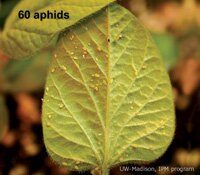
A Visual Guide to the Number of Soybean Aphids displays soybean leaflets with a specific number of aphids to help you make accurate counts when scouting this pest. From the University of Wisconsin IPM program. View the leaflet (pdf)» |
The threshold is set below the economic injury level (EIL)
Insecticide application to fields with soybean aphid populations below the economic threshold of 250 aphids/plant is not advised. The economic threshold (ET) of 250 aphids/plant is set below the Economic Injury Level (EIL), or "break-even" point where pest density causes yield losses equal to the cost of control.
For soybean prices within the $5.50-$6.50 range, the EIL, or number or aphids that need to be present for the value of lost yield to equal control cost, is approximately 674 aphids/plant. Under these crop prices, the Economic Threshold of 250 aphids/plant incorporates an approximate 7-day lead time between scouting and treatment to make spray arrangements or handle weather delays.
Adjusting for increased market value
At higher market value for soybeans, a lowered EIL can be calculated based on damage relationships between soybean aphids and soybean yield over a wide range of densities (see Economic Threshold for Soybean Aphid in the Journal of Economic Entomology 100: ). For example, for soybeans at $15/bushel, with $8 control costs, and anticipated yield of 50 bu/acre, the EIL is lowered from 674 aphids/plant to 450 aphids/plant. The Economic Threshold of 250 aphids/plant is still below this revised EIL of ~450 aphids/plant, but decreases the lead time to 3-4 days to treat before reaching the EIL. The Economic Threshold of 250 aphids/plant has not changed.
 |
| In University research trials across the upper Midwest, treating below 250 aphids/plant resulted in no detectable yield increase. Click on image to view a larger version. Photo credit: Chris DiFonzo, Michigan State University |
No gain in treating below threshold
In university research across the upper midwest, treating below 250 aphids/plant resulted in no detectable yield increase. 250 aphids/plant is not where economic injury begins, rather it is the action threshold at which to treat and prevent the field from reaching the EIL. In addition, early insecticide application will kill beneficial insects unnecessarily, allowing soybean aphid populations to rebound in a "natural enemy-free space". Optimal treatment timing, and greatest economic return, result from treating soybean aphids at the Economic Threshold.
Plants are likely to be considerably above threshold if stems or pods are covered with aphids and honeydew, sooty mold covers the bottom leaves, and plants are stunted. Insecticide treatment is probably still of value, but the optimal time for treatment (greatest economic return) is past.
Contributed by Eileen Cullen, entomologist at the University of Wisconsin-Madison