
- Agronomics
-
Diseases
- Asian Rust
- Anthracnose
- Bacterial Blight
- Bacterial Pustule
- Bean Pod Mottle Virus
- Brown Stem Rot
- Cercospora Leaf Blight
- Charcoal Rot
- Downy Mildew
- Frogeye Leaf Spot
- Green Stem Syndrome
- Iron Deficiency Chlorosis
- Phytophthora Root & Stem Rot
- Powdery Mildew
- Rhizoctonia
- Seedling Diseases
- Septoria (Brown Spot)
- SCN (Soybean Cyst Nematode)
- Soybean Mosaic Virus
- Stem Canker
- Sudden Death Syndrome
- Viruses
- White Mold
- Pests
- Biological Control
- Diagnostic Tools
- About Us
- Library
| Disease: Asian Rust |

Your soybean checkoff.
Delivering Results.
Asian Soybean Rust - Agronomic Impact
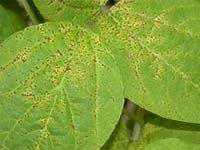 |
| The rust pathogen reduces both the amount and the efficiency of the green leaf area of the soybean plant. This reduces photosynthesis, which has a direct impact on yield. |
Asian soybean rust is an aggressive foliar disease that destroys photosynthetic tissue, causing premature defoliation and reduced yields. Rust infection affects pod filling, the number of seeds, and seed weight.
Yield losses where rust occurs range from 10-100%, depending on how early in the season the plant is infected. Plants are most susceptible in the early reproductive growth stages.
Yield Loss Prediction Tool
Over the past several years, soybean physiologists have determined that the "effective leaf area index" — a measure of the photosynthetic capacity of leaf tissue — is an accurate and measurable tool to predict yield loss due to rust infection. This physiological basis of yield loss is now being used to develop a model to help growers predict potential yield loss in areas where rust epidemics occur.
The interactive model will ask growers to supply the following information: yield potential (without rust), the growth stage of the crop, and an estimation of the severity of the epidemic (mild, moderate, or severe). Local Extension personnel can help growers determine the potential severity of the epidemic. The model will then calculate the yield potential (estimated yield loss with rust), the cost of treatment, and the economic benefit of treatment. Growers can access this interactive tool on a website that is currently under development at Yield Loss Prediction Tool for Field-Specific Risk Management of Asian Soybean Rust.