
- Agronomics
-
Diseases
- Asian Rust
- Anthracnose
- Bacterial Blight
- Bacterial Pustule
- Bean Pod Mottle Virus
- Brown Stem Rot
- Cercospora Leaf Blight
- Charcoal Rot
- Downy Mildew
- Frogeye Leaf Spot
- Green Stem Syndrome
- Iron Deficiency Chlorosis
- Phytophthora Root & Stem Rot
- Powdery Mildew
- Rhizoctonia
- Seedling Diseases
- Septoria (Brown Spot)
- SCN (Soybean Cyst Nematode)
- Soybean Mosaic Virus
- Stem Canker
- Sudden Death Syndrome
- Viruses
- White Mold
- Pests
- Biological Control
- Diagnostic Tools
- About Us
- Library
| Disease: Asian Rust |

Your soybean checkoff.
Delivering Results.
Assessing the Risk of Soybean Rust
| Sentinel Plot Program |
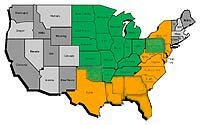 |
| The checkoff-supported sentinel plot program is an extensive system of monitored plots in U.S. soybean-producing states. The program is a cooperative effort of the NSCRP and USB (green) and the USDA (orange). |
Advance warning system
The threat of soybean rust started an unprecedented sentinel system developed within five months of the initial confirmation of rust in North America. Because of this system, we have not lost track of where soybean rust is since February 24, 2005.
Until rust-resistant soybean varieties are in place, the main decision that growers will face is if the potential for rust merits the application of a fungicide. The purpose of the national monitoring and forecasting network is to help producers assess the risk of a soybean rust epidemic in their area as the season progresses.
The network is designed to give producers a seven-day notice of when rust could arrive. It consists of
- a network of fields or plots monitored regularly for the presence of soybean rust (sentinel plots)
- a program that monitors the hosts of the rust pathogen
- a spore-tracking system that determines the presence of soybean rust spores
- climate-based epidemiological models that help to forecast spore spread and deposition
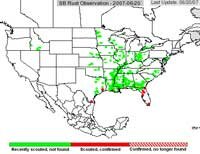 |
| Check the USDA ipmPIPE soybean rust maps frequently during the growing season. Click on your state for the latest state advisory. |
The advance warning network may be the soybean producers' best tool to manage rust. It is the most aggressive disease-monitoring program ever developed and is the collaborative effort of many universities, federal agencies, and checkoff organizations. The information is posted at the USDA Pest Information Platform for Extension and Education (ipmPIPE) website. Based on reports presented at the annual National Soybean Rust Symposium, several hundred people are involved in the sentinel plot system each season, and over 20,000 observations are uploaded to the ipmPIPE website. This represents an enormous amount of cooperative work.
Soybean rust in the North Central region depends on three key factors:
- The occurence of soybean rust during the spring and early summer in the Gulf Coast area, which determines the amount of spores to blow northward. Soybean rust does not overwinter in the north, and must spread from south to north each growing season.
- The weather conditions in July-August in the northern United States: if the weather is hot and dry, then rust will be less of a concern than if the weather is cool and wet. Rust requires wet leaf periods of at least 8 hours (in the form of rain or dew) and moderate temperatures of 60 to 80° F.
- The northward movement of soybean rust spores in large tropical or mid-lateral storms.
The USDA ipmPIPE website helps growers and advisors track the movement of soybean rust and, together with the weather conditions and long-range forecast, gauge the risk of soybean rust developing in northern states. Plant pathologists and epidemiologists in each state keep close track of this information throughout the growing season and make appropriate announcements when the risk of soybean rust is elevated.
Crop insurance
The brochure Soybean Rust, Crop Insurance and You, from the USDA Risk Management Agency, outlines how insured farmers must seek out and follow the good farming recommendations of agricultural experts such as extension agents and certified crop consultants—and also document the advice received and actions taken. It recommends that farmers follow the development and spread of Asian soybean rust, as well as treatments that may apply to their situation.
View Soybean Rust, Crop Insurance and You (pdf) »