
- Agronomics
-
Diseases
- Asian Rust
- Anthracnose
- Bacterial Blight
- Bacterial Pustule
- Bean Pod Mottle Virus
- Brown Stem Rot
- Cercospora Leaf Blight
- Charcoal Rot
- Downy Mildew
- Frogeye Leaf Spot
- Green Stem Syndrome
- Iron Deficiency Chlorosis
- Phytophthora Root & Stem Rot
- Powdery Mildew
- Rhizoctonia
- Seedling Diseases
- Septoria (Brown Spot)
- SCN (Soybean Cyst Nematode)
- Soybean Mosaic Virus
- Stem Canker
- Sudden Death Syndrome
- Viruses
- White Mold
- Pests
- Biological Control
- Diagnostic Tools
- About Us
- Library
| Disease: Seedling Diseases |

Your soybean checkoff.
Delivering Results.
Seedling Diseases - Management
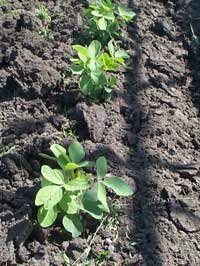 |
| Conditions that promote quick germination and strong seedling growth are the best defense against seedling disease. Photo credit: University of Nebraska |
What to do if seedling diseases are present
- If dead plants are scattered throughout the field, and no significant stand reduction is apparant, or replanting is not needed, then no action is needed if the disease is Pythium or Rhizoctonia damping-off.
- If the disease is Phytophthora damping-off and it occurs on a Phytophthora-resistant variety, your resistance has been defeated by the fungus. Consider using a variety with a better resistance gene for the next soybean crop.
- Although replanting is not always needed with stand reduction, root rot, especially Rhizoctonia root rot, and stem decay may appear later in plants that are infected but not killed as seedlings.
- Take good disease notes and use preventive measures such as seed treatment or resistant varieties to reduce the likelihood of a disease problem in the next soybean crop.
If replanting is necessary
- If poor stands are due to diseases, seed treatments with fungicides can be used in replanting to avoid further damping-off, especially for Rhizoctonia and Phytophthora. If poor stands are due to a low germination rate, a seed treatment cannot improve seed vigor or seed germination rate.
- Select chemicals according to the fungi that cause the seedling blight. See Table 1 or follow your state extension recommendations.
- Consider if a better seed bed could be prepared.
- Consider if soil drainage could be improved, or if low areas of fields could be avoided.
Cultural practices for healthy seedlings
The first 10 to 14 days following soybean planting is the window of opportunity for Pythium and other soil fungi to infect the plant. Implement practices that promote quick germination and seedling emergence to prevent infection:
- Plant seed of good quality
- Plant seed that has resistance to Phytophthora. Specific resistance is controlled by major resistance genes such as Rps1a, Rps1c or Rps1k (Rps stands for Resistance to Phytophthora sojae). In addition to Rps resistance, select varieties with high partial resistance (tolerance) when possible.
- Prepare a good seedbed
- Plant at the proper planting depth
- Do not expose seedlings to herbicides
- Plant where drainage is adequate, or improve drainage if possible. Avoid low areas of fields, especially if a field has a history of seedling or root rot problems.
- Consider that germination will be quickest when soil temperatures are greater than 65°F
- Damage by Rhizoctonia and Phytophthora beyond the seedling stages can be reduced by mid-eason cultivation. Cultivation mounds the soil around the base of soybean plants, which promotes new growth of roots.
When to treat seed with fungicides
Research over the years in all North Central states have shown no consistent significant yield improvement by treating seeds with fungicides unless there is a significant risk of seedling disease. Use field history as the key component of the decision-making process for managing seedling disease.
- Don't consider seed treatment unless there is a significant risk of seedling disease. Neither early planting nor the use of no-till alone indicates a decision to use seed treatment. Seed treatments may be worth considering in fields that have a history of seed rot, damping off, or premature stem and root decay, or in fields that are prone to slow germination due to poor drainage or other factors.
- It is critical that the correct fungicide treatment is used for effective disease control. In particular, the active ingredients mefenoxam or metalaxyl are effective against the water-mold pathogens Phytophthora and Pythium, but not against other fungal pathogens (see Table 1 below)..
- Fungicides used as protectants (contacts) are effective only on the seed surface, while systemic fungicides are absorbed by the emerging seedling and inhibit or kill the fungus inside host plant tissues. Contact fungicides usually have shorter residual activity than systemic fungicides. Contact fungicides used for soybean seed treatment include: captan, fludioxonil, PCNB and thiram. Systemic fungicides used for soybean seed treatment include: azoxystrobin, caroboxin, mefenoxam, metalaxyl, trifloxystrobin and thiabendazole.
- For broad-spectrum control of different pathogens, some products are a combination of active ingredients.
Table 1. Specific activity of soybean seed fungicides
|
Active Ingredient
|
Trade
names |
Pythium
|
Phytoph- thora
|
Rhizoctonia
|
Phomopsis
|
Fusarium
|
|
metalaxyl
|
Allegiance formulations
|
excellent
|
excellent
|
no activity
|
no activity
|
no activity
|
|
mefenoxam
|
Apron formulations
|
excellent
|
excellent
|
no activity
|
no activity
|
no activity
|
|
azoxystrobin + metalaxyl
|
SoyGaard
|
good
|
poor
|
good
|
good
|
good
|
|
captan
|
many
|
good
|
poor
|
good
|
fair
|
fair
|
|
captan + PCNB +thiabendazole
|
Rival
|
poor
|
poor
|
good
|
excellent
|
excellent
|
|
carboxin + thiram
|
Vitavax-200
|
poor
|
no activity
|
fair?
|
excellent
|
poor
|
|
carboxin + captan
|
Vitavax-captan
|
fair
|
poor
|
good
|
good
|
fair
|
|
fludioxonil
|
Maxim 4FS
|
poor
|
poor
|
good
|
good
|
good
|
|
fludioxonil + mefanoxam
|
ApronMaxx
|
good
|
good
|
good
|
good
|
good
|
|
PCNB + ethazole
|
Terraclor Super-X Terra-Coat L-205N
|
good
|
poor
|
good
|
no activity
|
poor
|
|
thiram
|
many
|
fair
|
poor
|
good
|
fair
|
fair
|
Sources
Scouting for soybean seedling diseases - ICM, Iowa State University
Seed Treatment Fungicides for Soybeans, University of Nebraska