
- Agronomics
-
Diseases
- Asian Rust
- Anthracnose
- Bacterial Blight
- Bacterial Pustule
- Bean Pod Mottle Virus
- Brown Stem Rot
- Cercospora Leaf Blight
- Charcoal Rot
- Downy Mildew
- Frogeye Leaf Spot
- Green Stem Syndrome
- Iron Deficiency Chlorosis
- Phytophthora Root & Stem Rot
- Powdery Mildew
- Rhizoctonia
- Seedling Diseases
- Septoria (Brown Spot)
- SCN (Soybean Cyst Nematode)
- Soybean Mosaic Virus
- Stem Canker
- Sudden Death Syndrome
- Viruses
- White Mold
- Pests
- Biological Control
- Diagnostic Tools
- About Us
- Library
| Disease: Frogeye Leaf Spot |


Your soybean checkoff.
Delivering Results.
Frogeye Leaf Spot Risk Assessment
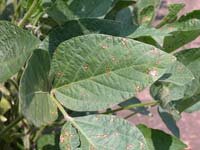 |
| Moist, warm weather favors frogeye leaf spot. Photo credit: A. Wrather, University of Missouri |
Frogeye leaf spot develops and spreads during warm, cloudy, humid weather when rain is frequent. Spores (called conidia) are carried by wind or rain and the disease can spread rapidly under these conditions. This disease will be rare when the weather is dry and hot.
Young expanding leaves are highly susceptible. Fully-expanded leaves are more resistant to infection. Even with artificial inoculation under ideal conditions, lesions seldom develop on fully-expanded leaves.
The frogeye leaf spot pathogen survives as mycelium (vegetative body of the fungus) in infected seeds or in soybean residue. The fungus can survive in soybean residue until the residue completely decomposes.
Seed infection is common. The germination rate of infected seed may be reduced, and the resulting seedlings are usually weak. Spores produced on the cotyledons of infected seedlings are the main source of inoculum for the leaf phase of the disease.