
- Agronomics
-
Diseases
- Asian Rust
- Anthracnose
- Bacterial Blight
- Bacterial Pustule
- Bean Pod Mottle Virus
- Brown Stem Rot
- Cercospora Leaf Blight
- Charcoal Rot
- Downy Mildew
- Frogeye Leaf Spot
- Green Stem Syndrome
- Iron Deficiency Chlorosis
- Phytophthora Root & Stem Rot
- Powdery Mildew
- Rhizoctonia
- Seedling Diseases
- Septoria (Brown Spot)
- SCN (Soybean Cyst Nematode)
- Soybean Mosaic Virus
- Stem Canker
- Sudden Death Syndrome
- Viruses
- White Mold
- Pests
- Biological Control
- Diagnostic Tools
- About Us
- Library
| Disease: Bean Pod Mottle Virus |


Your soybean checkoff.
Delivering Results.
Bean Pod Mottle Virus - Management
 |
|
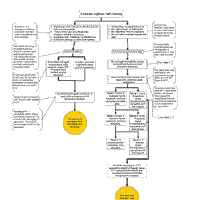
Researchers at Iowa State University have constructed a flowchart to help growers with insect/virus management decisions. View flowchart (pdf)» |
Although bean leaf beetles transmit BPMV all season long, soybeans are most affected when infection occurs in the seedling stage.
Current management options for managing bean pod mottle virus are:
- plant virus-free, certified soybean seed
- consider early-season insecticide treatments if BPMV has been confirmed in your fields in previous years and bean leaf beetles are present
- time soybean planting to avoid the highest populations of the bean leaf beetle. This can be done using a degree day model. The method is described in detail in the articles Predicting first-generation bean leaf beetles.
The development of virus-resistant or tolerant soybean varieties is an active area of research. Soybean varieties have been observed to differ in their tolerance to BPMV, and some progress has been made in quantifying those differences. No genes for resistance to BPMV have been identified in cultivated soybean, but BPMV resistance was detected in a closely related wild soybean species, Glycine soja.
Managing the bean leaf beetle for virus control
Researchers at Iowa State University have constructed a flowchart to help growers with insect/virus management decisions. The flowchart is a dynamic, two-pronged decision guide based on field history. If bean pod mottle virus has not been present in your fields, then the only reason to consider early-season bean leaf beetle management is if populations reach extremely high levels (more than 2.5 beetles per plant) and economic feeding damage can occur. Insecticide treatment will not be cost-effective if the virus is not present. View flowchart (pdf)»
Right now, most of the information for predicting economically important variables for beetle damage is available. More information is still needed regarding bean pod mottle virus. As more research is conducted, the results can be added to the decision guide.
Accurate diagnosis is the key to virus management
Soybean viruses are spread by different vectors and have very different management requirements. Therefore, it's important to know which viruses are most prevalent. Unfortunately, the symptoms caused by BPMV are similar to those caused by other viruses. This makes it difficult to diagnose BPMV and most other viruses based on symptoms alone.
Serological tests can accurately detect and distinguish among suspected viruses. Most diagnostic clinics in the North Central region are able to perform these tests.
References
Revisiting an integrated approach to bean leaf beetle and bean pod mottle virus management
ISU Integrated Crop Management Newsletter
Predicting first-generation bean leaf beetles (Integrated Crop Management Newsletter, Iowa State University)