
- Agronomics
-
Diseases
- Asian Rust
- Anthracnose
- Bacterial Blight
- Bacterial Pustule
- Bean Pod Mottle Virus
- Brown Stem Rot
- Cercospora Leaf Blight
- Charcoal Rot
- Downy Mildew
- Frogeye Leaf Spot
- Green Stem Syndrome
- Iron Deficiency Chlorosis
- Phytophthora Root & Stem Rot
- Powdery Mildew
- Rhizoctonia
- Seedling Diseases
- Septoria (Brown Spot)
- SCN (Soybean Cyst Nematode)
- Soybean Mosaic Virus
- Stem Canker
- Sudden Death Syndrome
- Viruses
- White Mold
- Pests
- Biological Control
- Diagnostic Tools
- About Us
- Library
| Disease: White Mold |


Your soybean checkoff.
Delivering Results.
White Mold - Scouting
 |
| This image illustrates how the apothecia are produced from a sclerotium (overwintering structure of the fungus). Photo credit: Jim Venette, North Dakota State University |
Scouting for mushrooms (apothecia)
The white mold disease cycle begins when sclerotia of Sclerotinia sclerotiorum, found on the soil surface, germinate to form mushroom-like structures about 1/3 inch in height called apothecia.
The best time to scout for apothecia is at canopy closure. In the north central region, this is generally in late June and early July, and will vary with row spacing. Check the soil under plants growing in high soil moisture areas, especially during flowering. Check areas where moisture collects due to fogs, extended dew periods, and in pockets of poor air drainage.
Under the mushroom cap of the apothecia, microscopic spores (ascospores) are produced which are ejected onto the dying flower petals adhering to young pods. Moderate air temperatures and frequent rain events during flowering favor germination and infection at this stage.
 |
 |
| These mushroom-like structures (called apothecia) are the beginning of the white mold disease cycle. Click on image to view a larger version. Photo credit: Angie Peltier, University of Illinois. |
Sometimes the apothecia of the white mold pathogen are confused with harmless mushrooms, such as the bird's nest fungus (above). Scouts should be aware of the difference between apothecia growing from sclerotia, and harmless fungi growing on pieces of organic matter. Click on image to view a larger version. Photo credit: Martin Chilvers, Michigan State University |
|
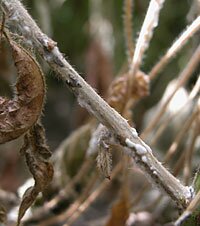
| White mycelium covering a soybean stem is a diagnostic sign of white mold. Click on image to view a larger version. Photo credit: Craig Grau |

|
| Sclerotia are hard, dark, structures that form on the inside and outside of the stem. Click on image to view a larger version. Photo credit: Craig Grau |
Scouting for white mold-infested plants
During pod set in August and September, scout for signs of infected plants.
Inspect stems for lesions, which may be covered with a thick white mold, the vegetative body of the fungus.
As the fungus grows from the young pods to the nodes and stem of the plant, it eventually girdles the stem and disrupts the transport of water and nutrients. Once the fungus girdles a stem, all the plant tissue up from the infection dies. Leaves and stems turn brown and stand erect above the soybean canopy.
Hard, dark structures called sclerotia form on the inside and outside of the stem and pods. The sclerotia fall to the soil during harvesting or remain in crop debris where they survive for many years.
In the spring, sclerotia may germinate to form the apothecia, starting the disease cycle again.
| Paul Esker, UW-Madison plant pathologist shows what to look for when you scout for white mold. He also talks about the best timing for scouting and control measures. |