
- Agronomics
-
Diseases
- Asian Rust
- Anthracnose
- Bacterial Blight
- Bacterial Pustule
- Bean Pod Mottle Virus
- Brown Stem Rot
- Cercospora Leaf Blight
- Charcoal Rot
- Downy Mildew
- Frogeye Leaf Spot
- Green Stem Syndrome
- Iron Deficiency Chlorosis
- Phytophthora Root & Stem Rot
- Powdery Mildew
- Rhizoctonia
- Seedling Diseases
- Septoria (Brown Spot)
- SCN (Soybean Cyst Nematode)
- Soybean Mosaic Virus
- Stem Canker
- Sudden Death Syndrome
- Viruses
- White Mold
- Pests
- Biological Control
- Diagnostic Tools
- About Us
- Library
| Disease: Northern Stem Canker |


Your soybean checkoff.
Delivering Results.
Northern Stem Canker - Symptoms

|
|
Soybean stem canker showing late symptom expression of withered leaves that remain attached and green tissue both above and below the infected region.
Click on image to view a larger version Photo credit: Paul Esker, University of Wisconsin |
Early symptoms of stem canker include slightly sunken, reddish-brown lesions usually at the base of lower leaf or branch nodes. They are usually seen during reproductive growth, long after infections have occurred during early vegetative growth.
Eventually the expanding canker may girdle the main stem, causing the plant to wilt and die. A diagnostic symptom of stem canker is green stem tissue present both above and below individual stem cankers. Brown discoloration may also develop inside the stem.
Toxins may be transported to foliar tissue, causing an intervienal necrosis very similar to foliar symptoms of Brown stem rot or Sudden death syndrome.
Lesions may occur at the soil line, making it possible to confuse this disease with Phytophthora stem and root rot. Stem canker, however, does not cause root rot, and the lesions lengthen down the stem. Lesions caused by the Phytophthora fungus begin on the roots and elongate up the stem.
Disease Cycle
Infection by the stem canker pathogen takes place early in the season on plants in the early vegetative growth stages. Rain-splashed ascospores and possibly conidia from the soil act as the primary inoculum. Warm temperatures during wet weather is optimum for disease development.
|
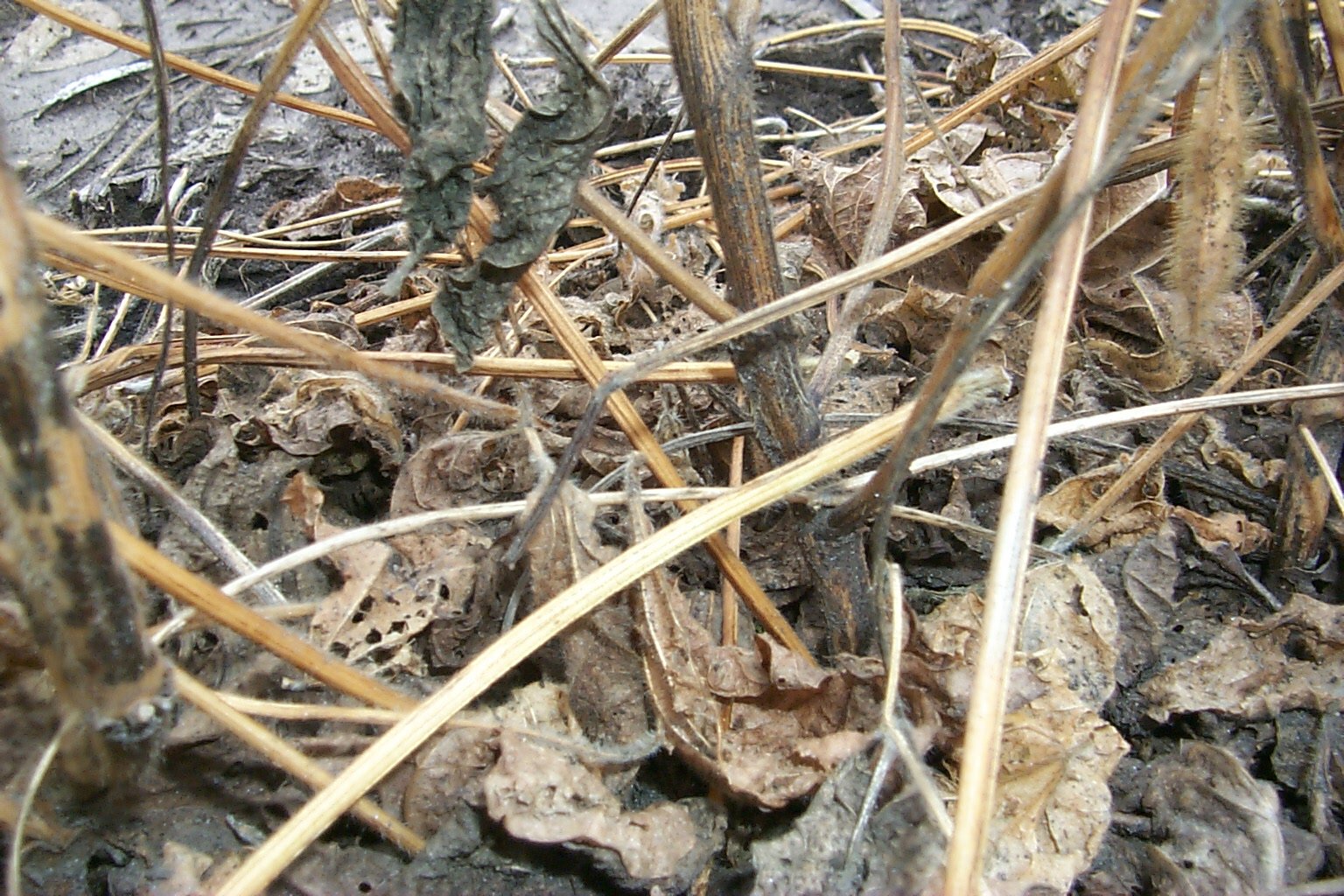
| Plants with Northern stem canker retain blackened, wilted leaves, but these are not entirely diagnostic. Lower stems of plants should be examined for stroma and/or perithecia of the fungus. Click on image to view a larger version Photo credit: Thoms Chase, SDSU |

|
| Close-up of stroma of Diaporthe phaseolorum var. caulivora on a soybean stem. Stroma are compact masses of fungal hyphae which the fungus forms as a means of survival. Pertithecia will arise from stroma given appropriate levels of moisture. Click on image to view a larger version Photo credit: Thomas Chase, SDSU |

|
| Perithecia (fruiting bodies) on a naturally-infected soybean stem incubated in a moist chamber. Click on image to view a larger version Photo credit: Thomas Chase, SDSU |
Infection appears to be highly dependent on the timing of rainfall early in the season to provide a rain splash mechanism for infection. Researchers in South Dakota have observed that even when high levels of Diaporthe phaseolorum var. caulivora occur in surface residue in no-till fields, infection did not occur in the absence of rainfall. In some cases, stems at the soil line may be infected directly from the fungus in the soil.
The fungus survives as mycelium (vegetative tissue, called stroma) and as clusters of long-necked, black fruiting bodies (perithecia) on infected residue on or in the soil for many years. This may explain why fields that have not been planted to soybeans for years can still develop a high level of Northern stem canker when soybeans are re-introduced to the rotation.
The stem-canker fungus can also survive in infected seed. Levels of seed infection by D. phaseolorum var. caulivora are thought to range from 10 to 20%, and may be an important source of long-range dissemination of this fungus.